
A 5-point racing harness is one of the most important pieces of race car safety equipment you can install in a grassroots race car. Compared with a factory seat belt, a properly installed racing harness provides much better driver containment during racing and can be especially important during a serious crash.
Grassroots racers are good at finding ways to save money. We reuse parts. We build cars in our garages. We search junkyards and parts piles. We figure out how to make inexpensive cars survive on a racetrack.
But a driver’s restraint system is one place where saving a few dollars can have serious consequences.
After more than 30 years of Enduro racing, I’ve experienced firsthand why a proper racing harness matters. Years ago, I had just installed a 5-point harness in my race car when the throttle stuck wide open. I went headfirst into a concrete wall.
I walked away from that crash believing the harness may have prevented me from being severely injured—or worse. Had I been relying only on the factory seat belt, I don’t know what the outcome would have been.
That’s why, if someone asks me what safety upgrade I would make first when building a low-budget race car, my answer is simple: install a proper racing harness.
What Is a 5-Point Racing Harness?
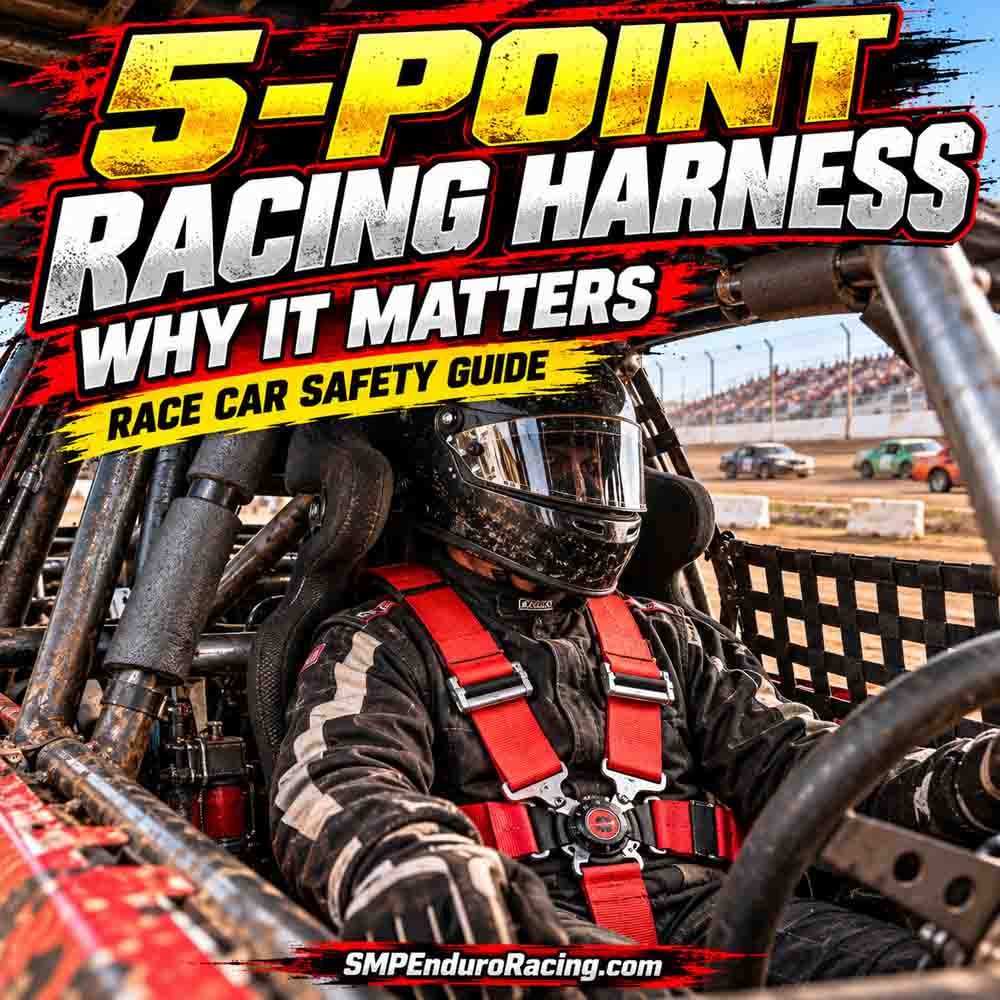
A 5-point racing harness is a driver restraint system designed to secure the driver’s body in the racing seat from multiple directions.
A typical 5-point harness includes:
- Two shoulder belts
- Two lap-belt attachment points
- One anti-submarine or crotch strap
These belts come together at a central buckle and work together to restrain the driver’s pelvis and upper body.
That’s considerably different from the factory 3-point seat belt found in most passenger vehicles.
Factory restraint systems are engineered as part of an entire street-car safety system that can include airbags, pretensioners, load limiters, collapsible structures and factory seats. Once a vehicle is converted into a race car, much of that original system may be removed or changed.
A properly selected and installed racing harness is designed for a very different environment.
5-Point Racing Harness vs. Factory Seat Belt
One of the biggest differences between a racing harness and a factory seat belt is how firmly the driver is held in position.
A factory 3-point belt crosses the body at three primary locations. It works extremely well for the street vehicle and safety system it was engineered for, but grassroots racing subjects the driver to repeated forces that normal street driving doesn’t.
During an Enduro race, for example, the car can experience constant cornering forces, hard braking, contact with other cars, ruts, bumps and sudden impacts.
With a factory seat and factory belt, the driver can move around considerably.
A properly installed racing harness combined with an appropriate racing seat helps hold the driver’s body in a consistent position. That isn’t only important during a crash. It can also reduce the amount of energy the driver spends trying to brace himself against the steering wheel, door or floor while racing.
Why a Racing Harness Matters in a Serious Crash
My own experience is the reason I’m particularly serious about this subject.
The throttle stuck wide open on one of my Enduro cars and I hit a concrete wall head-on. I had recently installed a 5-point racing harness.
It was a violent impact, and afterward I couldn’t help thinking about what might have happened if I had still been using the factory restraint.
No safety device can guarantee that someone won’t be injured in a race car. Auto racing carries real risk regardless of the equipment installed.
But the purpose of a racing restraint system is to manage the driver’s movement during an impact and work with the seat and other safety equipment to protect the occupant as effectively as possible.
That experience changed the way I looked at racing harnesses. To me, they’re not an optional performance accessory. They’re fundamental race car safety equipment.
A 5-Point Harness Also Helps While You’re Racing
The benefit isn’t limited to crashes.
If you’ve ever raced hard while sitting in a stock seat with a factory belt, you know how much you can move around inside the car.
Your body wants to slide toward the outside of every corner. You instinctively brace yourself with your legs or arms. That means some of your effort is being spent simply trying to remain positioned behind the steering wheel.
A racing harness and properly installed racing seat can substantially improve driver containment.
The driver should be able to concentrate on steering, throttle, braking, traffic and track conditions rather than trying to keep his body in the seat.
Don’t Forget the Racing Seat
A harness is only one part of the driver’s overall restraint system.
A proper racing seat is another upgrade worth considering, particularly when converting a street vehicle into a grassroots race car.
The seat, harness, roll cage, helmet and other driver-protection equipment should be thought of as a system rather than completely independent parts.
That’s also why the location of the racing seat should be established before permanently mounting the harness.
When I build a car, I first determine where the seat needs to be positioned for me. Once the seating position is established, I can determine appropriate harness mounting locations based on that seating position and the requirements of the harness manufacturer and racing organization.
Proper 5-Point Harness Installation Is Critical
Buying a good racing harness doesn’t automatically make the car safer. It must also be installed correctly.
Mounting location, mounting strength, belt routing and belt angles all matter.
The SFI Foundation publishes a motorsports seat-belt installation guide that addresses shoulder, lap and crotch-belt geometry. For upright seating, SFI’s guidance shows shoulder belts generally running from horizontal to approximately 20 degrees downward from the driver’s shoulders, with approximately 10 degrees downward identified as an optimum angle for the systems covered by its guide.
Do not simply copy a belt angle from another race car. Follow the instructions supplied by your harness manufacturer and the rules of your racing organization. Seat design, seating position and other restraint equipment can affect the proper installation.
Read the SFI Seatbelt Installation Guide →
Use Strong Harness Mounting Points
The mounting points need to be capable of handling the loads generated during a crash.
A harness attached to an inadequate mounting point can create a false sense of security. The belts themselves may be strong, but the restraint system is only as dependable as its installation.
Never assume that thin sheet metal or a convenient existing bolt is automatically an acceptable harness mounting point.
Follow the harness manufacturer’s instructions and your sanctioning body’s requirements for mounting hardware, reinforcement, harness bars and attachment methods.
Keep the Belts Properly Routed
Harness webbing should have a clear path and should not be routed across sharp edges or surfaces that can damage or abrade it.
SFI specifically advises that straps should not rub against surfaces capable of causing the webbing to fray and that anchoring mechanisms should be periodically checked for loosening or weakening.
Inspect the complete routing whenever the seat, cage or harness installation is changed.
How Tight Should a Racing Harness Be?
A racing harness isn’t intended to hang loosely around the driver like a comfortable street belt.
It needs to be properly adjusted to the driver.
The lap belts should properly restrain the pelvis, and the shoulder belts should be tightened according to the harness manufacturer’s instructions. The anti-submarine strap must also be properly positioned and adjusted.
The FIA’s safety-harness guidance emphasizes proper harness tension and notes that harness fit and routing are important parts of the restraint system’s operation.
Before entering the track, make belt adjustment part of your normal pre-race routine.
Inspect Your Racing Harness Regularly
A racing harness shouldn’t be installed and then forgotten.
Before racing, inspect the webbing, mounting points, adjusters and buckle.
Look for:
- Frayed or damaged webbing
- Cuts or abrasion
- Loose mounting hardware
- Corrosion or damaged attachment points
- Improper belt routing
- Damaged adjusters or buckle components
- Changes to the seat or cage that affect belt geometry
Certification dates and replacement requirements also matter. Different racing organizations have different rules regarding harness age and certification, so always check the current rules where you race.
Is a $100 Racing Harness Worth It on a Cheap Race Car?
This is where grassroots racing sometimes gets things backward.
A racer might build an entire Enduro car for a relatively small amount of money and then hesitate to spend roughly another $100 on driver safety equipment.
To me, that’s the wrong place to save money.
If I were building a low-budget race car and could make only one major upgrade beyond what the minimum rules allowed, a 5-point racing harness would be at or near the top of my list.
You can race with an ugly car.
You can race with faded paint.
You can race without expensive performance parts.
None of those things is more valuable than protecting the person sitting behind the steering wheel.
Are 5-Point Harnesses Required in Enduro Racing?
Rules vary considerably between tracks, promoters and sanctioning organizations, so racers should never assume that one organization’s rules apply everywhere.
At Southern Minnesota Promotions, a 5-point racing harness with lap and shoulder belts is mandatory under the current Enduro rules.
Drivers preparing an SMP car should always review the current rules before building or modifying the vehicle.
Read the SMP Compact Enduro Rules →
Race Car Safety Equipment Should Work Together
A 5-point harness is extremely important, but it shouldn’t be viewed as the only safety component in the car.
Driver protection can include a properly constructed roll cage, racing seat, helmet, fire suit, window net, fire extinguisher, roll-cage padding and other equipment appropriate to the type of racing.
We’ve put together a broader checklist for racers who are building a car or reviewing their existing safety equipment.
See the Enduro Race Car Safety Equipment Checklist →
5-Point Racing Harness FAQ
Is a 5-point harness safer than a factory seat belt for racing?
A racing harness is specifically designed as part of a motorsports restraint system, while a factory 3-point belt is engineered as part of the original street vehicle’s complete safety system. Once a vehicle is converted for competition, racers should use the restraint equipment required by their sanctioning organization and install it according to the manufacturer’s instructions.
What are the five points on a 5-point racing harness?
A typical 5-point harness uses two shoulder belts, two lap-belt attachment points and one anti-submarine or crotch strap that connect through a central buckle.
Can I mount a racing harness to the floor?
Harness mounting depends on the specific belt, vehicle, seat, cage and sanctioning rules. Do not choose mounting locations simply because they’re convenient. Follow the harness manufacturer’s instructions and applicable racing regulations.
What angle should 5-point harness shoulder belts be mounted at?
There is no substitute for the instructions supplied with your specific restraint system. SFI guidance for upright seating shows shoulder belts generally between horizontal and 20 degrees downward, with approximately 10 degrees downward identified as optimum for the systems addressed by its guide. Always verify the requirements for your equipment and racing organization.
Should I replace an old racing harness?
Inspect harnesses for physical damage and check their certification and the rules of the organization where you race. Some sanctioning bodies specify harness age or certification requirements. When in doubt about the condition or eligibility of an old restraint, replacing it is inexpensive compared with the consequences of restraint failure.
Do I need a racing seat with a 5-point harness?
A racing seat can improve driver containment and provide proper routing provisions for a racing harness. The seat and harness should be selected and installed as parts of the overall driver-restraint system rather than treating each component independently.
The Bottom Line: Don’t Cheap Out on the Part Holding You in the Car
Grassroots racing is supposed to be affordable. That’s part of what makes Enduro racing and other entry-level forms of motorsports so much fun.
But low-budget racing shouldn’t mean ignoring basic driver protection.
I learned that lesson personally when a stuck throttle sent me headfirst into a concrete wall. I was wearing a 5-point harness, and I walked away believing that decision may have prevented a much more serious outcome.
If you’re building a grassroots race car and deciding where to spend your limited budget, put driver safety near the top of the list.
A properly selected, properly installed and properly adjusted 5-point racing harness is one of the best places to start.