
Racing Fire Suits: 4 Best Budget to Premium Options
When shopping for racing fire suits, you don’t have to spend $1,000 to get started. Whether you’re entering your first dirt track Enduro or upgrading your safety equipment after years of racing, there are affordable options for nearly every budget.
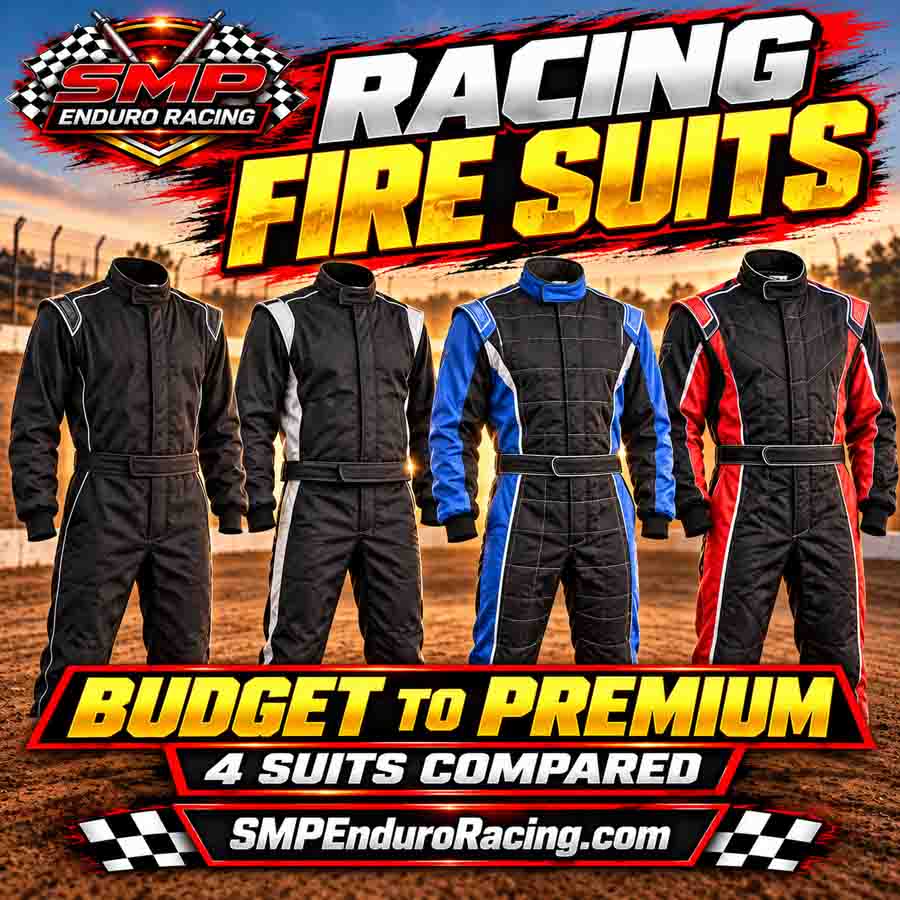
But how much protection does a $90 racing suit provide compared with a $400 or $1,000 suit? And is a one-piece racing suit better than a two-piece outfit?
At SMP Enduro Racing, safety comes first. Our series brings together experienced veterans and first-time drivers, and a racing fire suit is required for competitors. Other tracks and racing organizations may have different requirements, so always check your rulebook before purchasing safety equipment.
I’ve been involved in Racing for more than 30 years. During that time, I’ve worn inexpensive single-layer suits and invested approximately $1,000 in a custom, multilayer racing suit. I’ve experienced engine-related flash fires, encountered overheated electrical wiring inside a race car, and witnessed other drivers escaping burning vehicles.
Those experiences have taught me that a fire suit is one piece of safety equipment you should take seriously.
In this guide, we’ll compare four racing fire suit options, starting with an economical one-piece suit and working up to premium multilayer protection.
Affiliate disclosure: As an Amazon Associate, I earn from qualifying purchases. This does not increase your purchase price. Product information and prices are based on the listings reviewed for this article. I have not personally tested the four specific products featured below.
Quick Comparison: 4 Racing Fire Suits for Different Budgets
| Racing Fire Suit | Advertised SFI Rating | Construction | Listed Price |
|---|---|---|---|
| RaceQuip Chevron-1 | SFI 3.2A/1 | One-piece, single-layer | $89.95 |
| PROFOX-102 Jacket + PROFOX-103 Pants | SFI 3.2A/1 | Two-piece, single-layer | $194.00 combined |
| RaceQuip Chevron-5 | SFI 3.2A/5 | One-piece, two-layer | $422.99 |
| Sparco Competition | SFI 3.2A/5; FIA approval advertised | One-piece, triple-layer | $999.00 |
Prices are snapshots from Amazon listings and may change by size, color, seller, or availability. Verify the certification label and your racing organization’s requirements before buying.
1. RaceQuip Chevron-1 — Best Low-Budget Racing Fire Suit
Listed price: $89.95
Advertised certification: SFI 3.2A/1
If you’re just getting started in grassroots auto racing, the RaceQuip Chevron-1 is the lowest-priced complete racing suit in our comparison.
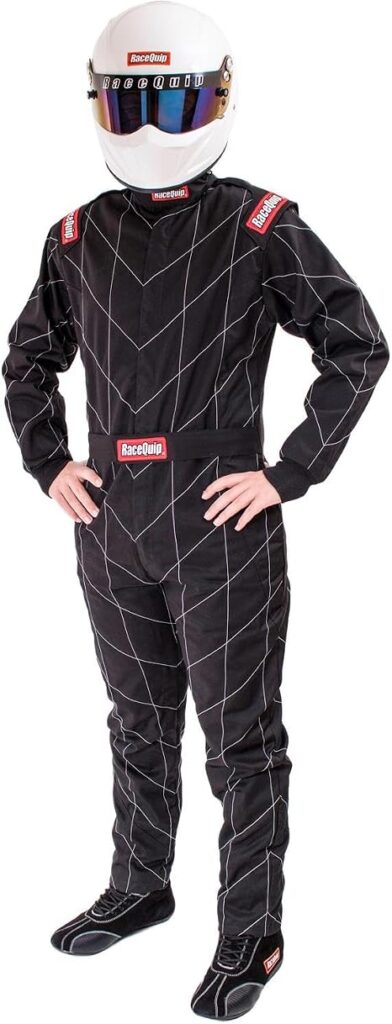
This one-piece suit features single-layer Pyrovatex fire-retardant cotton construction, stretch panels for movement, and a modern racing appearance. Its Amazon listing advertises an SFI 3.2A/1 rating and a Thermal Protective Performance (TPP) value of 11.
For a new racer trying to purchase a helmet, harness, fire suit, gloves, and other required equipment, keeping initial costs manageable can be important.
Why consider this racing fire suit?
- Complete one-piece suit at an entry-level price.
- Advertised SFI 3.2A/1 certification.
- Lightweight single-layer construction.
- Stretch panels designed to improve movement.
- Traditional racing appearance without a premium price.
What are the drawbacks?
A single-layer SFI 3.2A/1 suit provides a lower certified level of thermal protection than an SFI 3.2A/5 suit. It may also make sense to budget for an upgrade if you expect to race regularly for many years.
My experience: My first racing fire suit, which was a gift from family member during my first year of racing, cost approximately $100 back then. It wasn’t this particular RaceQuip model, but it was a similar entry-level purchase.
That first suit served its purpose, but it ripped repeatedly. I had seams repaired several times and even needed the zipper replaced. Fortunately, I had someone who could help with the repairs.
Within approximately three years, I upgraded to a better suit. By then, I knew I loved racing and planned to stay involved.
That’s how I look at entry-level racing fire suits today: they can be a practical starting point when they meet your racing organization’s requirements, but don’t assume the cheapest option will be your last purchase.
Check the RaceQuip Chevron-1 on Amazon
2. PROFOX Two-Piece Racing Fire Suit — Best for Pit-Area Convenience
Listed combined price: $194.00
Advertised certification: SFI 3.2A/1
The PROFOX two-piece racing outfit takes a different approach by offering the jacket and pants as separate purchases.
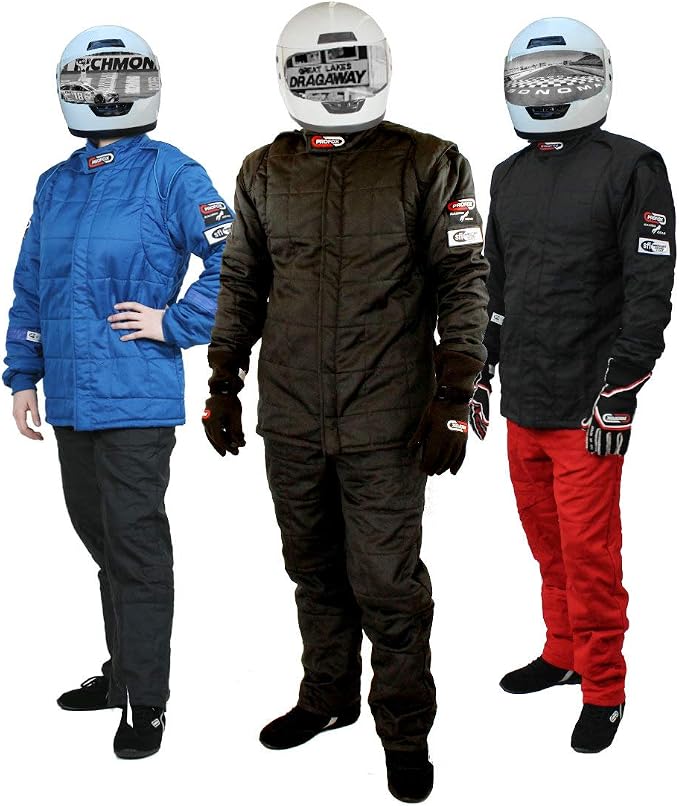
The PROFOX-102 jacket was listed for $99, while the matching PROFOX-103 pants were listed for $95, bringing the combined clothing price to approximately $194 before shipping.
Both listings advertise single-layer SFI 3.2A/1 construction.
PROFOX-102 Racing Jacket — $99
The jacket is sold separately, making it possible to purchase or replace the upper portion of the outfit without buying an entirely new suit.
View the PROFOX Racing Jacket on Amazon
PROFOX-103 Racing Pants — $95
The matching pants are also sold separately, providing another replacement option if one garment becomes worn or damaged.
View the PROFOX Racing Pants on Amazon
Why choose a two-piece racing suit?
One of the biggest advantages is convenience between races.
On a hot day at the racetrack, a driver can remove the jacket while relaxing in the pits. With a one-piece suit, drivers often pull the upper half down and tie the sleeves around their waist.
I’ve done that plenty of times. The extra fabric can become bulky, especially when bending over, walking around, or preparing for the next race.
A two-piece outfit can also make replacing individual garments more convenient, provided the replacement pieces meet the applicable safety requirements.
What are the drawbacks?
A two-piece racing suit must fit correctly and maintain the required overlap between the jacket and pants. SFI specifies a minimum 8-inch overlap for compliant two-piece configurations.
Removing the jacket between races is a convenience feature, not permission to compete without it. Both garments must be worn correctly when racing.
And remember, the PROFOX outfit’s advertised SFI 3.2A/1 rating is the same rating advertised for our less expensive RaceQuip Chevron-1. Its higher combined price doesn’t automatically mean greater certified fire protection.
My experience: I’ve personally always raced in one-piece suits, so I can’t claim firsthand ownership experience with a two-piece outfit. However, I can certainly relate to the inconvenience of having the upper half of a one-piece suit hanging around your waist between races.
3. RaceQuip Chevron-5 — Best Midrange Multilayer Racing Fire Suit
Listed price: $422.99
Advertised certification: SFI 3.2A/5
For racers who want to invest in a higher level of certified fire protection, the RaceQuip Chevron-5 represents a meaningful step up from the entry-level options.
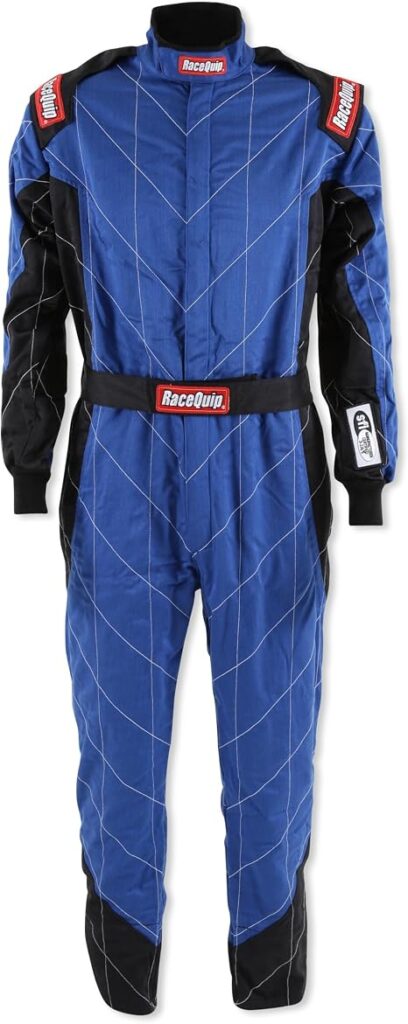
This one-piece racing suit features two-layer construction, with a Nomex outer layer and Nomex inner liner according to its Amazon listing.
The advertised SFI 3.2A/5 certification is the major difference. Compared with SFI 3.2A/1, the 3.2A/5 classification requires greater tested thermal protection.
Features worth considering
- Advertised SFI 3.2A/5 certification.
- Two-layer Nomex construction.
- One-piece racing design.
- Stretch panels to improve flexibility.
- Floating arm gussets designed to help driver movement.
Why spend more?
Fire protection is one of the most important reasons.
If you’re planning to race for several seasons, a higher-rated suit may be a worthwhile investment. The additional construction and materials can also influence comfort, fit, and durability, although those qualities vary by model.
The trade-off is that heavier protective clothing can feel considerably hotter during summer racing.
My experience: I’ve worn both lightweight single-layer suits and a much heavier premium multilayer suit.
On a humid afternoon at the track when temperatures reach 90 degrees, the difference in comfort is substantial. My lighter suit is much easier to tolerate in the heat.
But I also recognize that my heavier suit offers a different level of protection. When comparing the two, I look at their actual safety ratings rather than thickness alone.
For someone committed to racing, I would generally recommend purchasing the highest suitable SFI-rated suit they can reasonably afford.
Check the RaceQuip Chevron-5 on Amazon
4. Sparco Competition — Premium Triple-Layer Racing Fire Suit
Listed price: $999.00
Advertised certification: SFI 3.2A/5, with FIA approval also advertised
At the premium end of our comparison is the Sparco Competition one-piece racing suit.
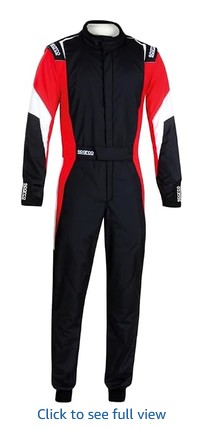
Its Amazon listing advertises triple-layer construction, an SFI 3.2A/5 rating, and FIA approval.
Sparco is a well-known name in motorsports, and this suit offers a more premium option for drivers shopping beyond the entry-level price range.
Why consider a premium racing suit?
- Triple-layer construction.
- Advertised SFI 3.2A/5 certification.
- FIA approval advertised by the seller.
- Professional one-piece racing appearance.
- A premium option for racers who prioritize equipment quality and fit.
It’s important to understand that the Sparco and the less expensive RaceQuip Chevron-5 both advertise SFI 3.2A/5 ratings. The Sparco’s third layer and higher price do not, by themselves, prove that it has a higher certified protection classification.
View the Sparco Competition Racing Suit on Amazon
My experience owning a $1,000 racing suit
I purchased a custom-embroidered racing suit approximately 20 years ago for around $1,000.
I’ve taken very good care of it, and to the best of my recollection, I’ve never needed to repair it.
Compare that with my first inexpensive suit, which repeatedly needed sewing and even a replacement zipper.
That doesn’t mean every expensive racing suit will last 20 years, or that every inexpensive suit will fall apart. It’s simply what I’ve experienced over decades of racing.
The premium suit has been a worthwhile purchase for me because I knew I was going to continue racing.
However, after 20 years, a suit’s age, certification, condition, and compliance with current racing rules must be evaluated. A garment looking good does not guarantee that it retains its original protective performance.
One-Piece vs. Two-Piece Racing Fire Suits: Which Is Better?
Both designs have advantages, and the best choice depends on the driver, the suit’s certification, and the racing organization’s rules.
| One-Piece Racing Suit | Two-Piece Racing Suit |
|---|---|
| Traditional full-body racing design | Separate jacket and pants |
| No jacket-to-pants opening | Requires correct waist overlap |
| Upper half can be bulky when removed in the pits | Jacket can be removed between races |
| Fit must accommodate the entire body | Separate pieces may offer sizing flexibility |
| Entire suit may need replacement if extensively damaged | Individual pieces may be replaceable |
A one-piece suit is not automatically safer than a properly fitted and certified two-piece suit with the same protection rating.
Personally, I’ve always preferred one-piece racing suits, partly because I like their traditional professional appearance.
But the convenience of a two-piece suit is easy to understand, especially during long summer race days.
Regardless of which style you choose, both pieces of a two-piece outfit must be worn correctly while racing, and the entire protective system must meet the applicable rules.
Understanding SFI Ratings on Racing Fire Suits
When comparing racing fire suits, one of the most important things to look for is the SFI certification rating.
SFI ratings reflect standardized testing of protective performance. They’re more useful than judging a suit simply by its price, thickness, or number of layers.
SFI 3.2A/1
This is a lower protection classification commonly associated with entry-level racing suits. It may be permitted in some forms of racing, depending on the rulebook.
SFI 3.2A/5
This classification requires greater tested thermal protection than SFI 3.2A/1 and is common among more protective multilayer racing suits.
Higher SFI classifications also exist.
A fire suit is designed to reduce heat exposure and provide valuable protection during an emergency. It does not make a driver fireproof or guarantee a particular amount of escape time.
Before buying, confirm that the garment has a genuine, appropriate certification label and meets the requirements of your track or sanctioning body.
For additional information about safety equipment, visit the SFI Foundation.
What 30 Years of Racing Have Taught Me About Fire Protection
I’ve been fortunate during my racing career, but I’ve experienced situations that could have turned out much worse.
On one occasion, an engine failure sprayed oil onto hot components and caused a flash fire. Thankfully, other safety measures prevented the fire from entering the cockpit.
I’ve also experienced an electrical problem where wiring burned inside the car. There weren’t open flames, but contact with the overheated wiring could have caused serious burns.
And I’ve watched other drivers escape race cars that subsequently became engulfed in flames before fire crews extinguished them.
Those experiences remind me that fire protection matters, even when you’re racing at a small local dirt track.
The goal is to have the right safety equipment in place before an emergency happens.
A properly rated fire suit, suitable gloves and footwear, a helmet, a well-prepared race car, and a capable track safety crew all contribute to driver safety.
Should You Wear Fire-Resistant Underwear Beneath Your Racing Suit?
Properly rated flame-resistant underwear can provide an additional protective layer as part of a compatible racing safety system.
I’ve purchased and worn racing-specific fire-resistant underwear myself.
I tend to use it more often on cooler race days because additional clothing increases body heat, particularly during long Enduro events.
The important point is to select underwear designed for motorsports and follow the manufacturer’s guidance. Ordinary clothing should not be assumed to provide the same protection.
And don’t treat extra underwear as an automatic substitute for a fire suit that meets your racing organization’s required certification.
Looking Professional: Racing Suits, Sponsors, and Victory Lane
There’s another advantage to owning a clean, professional-looking racing suit that doesn’t get discussed enough: sponsor visibility.
Imagine two equally competitive drivers winning races.
One climbs out of the car wearing jeans and a flannel shirt. The other climbs out wearing a clean racing suit with their name, car number, and sponsor logos.
Which driver provides the better promotional opportunity in a victory-lane photograph?
As someone who’s spent decades around grassroots racing, I believe professional presentation can make a difference when you’re trying to attract sponsors.
A racing suit can become another advertising surface for the businesses supporting your racing program.
Custom racing suits are available with driver names, car numbers, embroidered sponsor logos, and personalized designs.
If you’re shopping for a custom suit, make sure any embroidery, patches, or alterations are approved for that particular garment and don’t compromise its protective performance.
And remember: appearance is a benefit, but certification and protection must always come first.
Racing Fire Suits Make Great Christmas, Birthday, and Father’s Day Gifts
If someone in your family is passionate about racing, safety equipment can make a practical and appreciated gift.
Over the years, when someone asked me what I wanted for Christmas or my birthday, racing equipment was always something I could put to good use.
A new fire suit can be a particularly meaningful gift for a young racer, a driver just starting out, or someone who’s been wearing the same equipment for years.
Other useful racing safety gifts include helmets, gloves, racing shoes, and fire-resistant underwear.
Before purchasing a fire suit as a gift, confirm the driver’s measurements, preferred style, and required SFI rating. For an expensive suit, involving the driver in the selection is usually the safest approach.
SMP Enduro Racing: Safety Comes First
At SMP Enduro Racing, we welcome both experienced drivers and newcomers who are discovering the excitement of grassroots Enduro racing.
Our goal is to provide competitive racing while emphasizing driver safety.
A racing fire suit is required for SMP Enduro Racing competitors.
Other local racing divisions may have different safety requirements, but drivers entering an SMP event should review the current rules before arriving at the track.
This article is intended to help racers understand their shopping options. It is not a replacement for the official rules or the safety inspection process.
You can also review our Enduro Race Car Safety Equipment Guide for more information about preparing a race car and its driver.
Always consult the current Compact or Full-Size division rules on SMPEnduroRacing.com for the specific requirements applicable to your class.
Final Thoughts: Which Racing Fire Suit Should You Buy?
For a first-time racer working with a tight budget, the RaceQuip Chevron-1 is our lowest-priced featured complete suit, provided its certification meets the applicable rules.
For drivers who value pit-area convenience, the PROFOX two-piece outfit offers separate jacket and pants options.
For racers seeking a higher certified protection level without approaching $1,000, the RaceQuip Chevron-5 is a strong option to investigate.
And for those shopping at the premium end, the Sparco Competition demonstrates what a more expensive triple-layer racing suit can offer, although the featured listing had limited availability.
My advice after more than 30 years of racing is simple:
Buy the highest suitable SFI-rated racing suit you can reasonably afford, make sure it fits correctly, and take good care of it.
You can always upgrade as your racing experience grows.
The important thing is to make safety a priority from the very beginning.
This article contains Amazon affiliate links. As an Amazon Associate, I earn from qualifying purchases. Prices, certification claims, and availability should be verified before ordering.
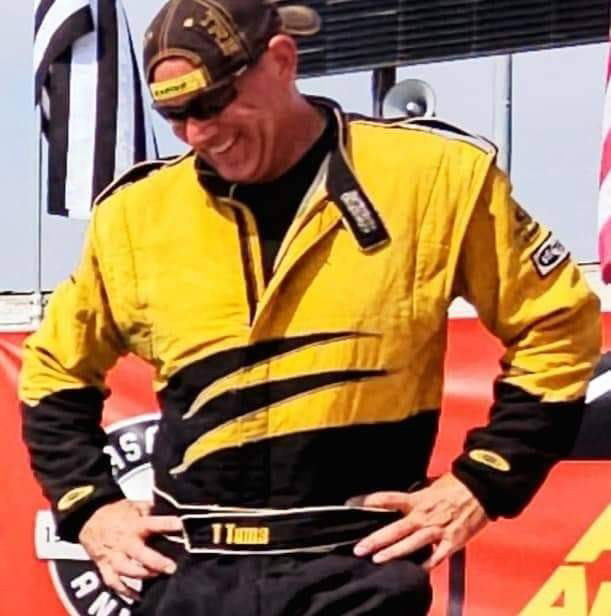
About the Author
Troy Tuma has been involved in circle track racing for over 30 years. His racing career began in 1994 at Raceway Park in Shakopee, Minnesota, competing in Enduro races before working his way up through the ranks to NASCAR Late Model racing. Throughout his career, Troy has earned victories at more than 13 racetracks across the Upper Midwest. Today, he enjoys returning to his grassroots racing roots, competing in Enduro events throughout the Midwest for the simple enjoyment and excitement of racing.