
Race car fire extinguishers are an essential part of motorsports safety. Whether you’re racing Enduros, dirt track, asphalt oval, or competing in a professional racing series, having the right fire protection can make a critical difference when something goes wrong.
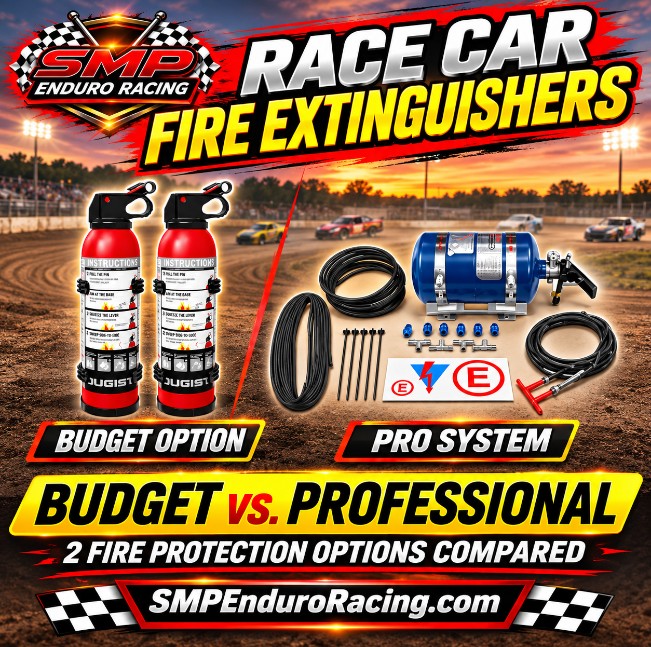
But how much should you spend? Can an affordable portable fire extinguisher do the job, or is a professional onboard fire-suppression system worth hundreds of dollars?
After more than 30 years of circle track racing, I’ve seen firsthand how quickly a mechanical problem can turn into a dangerous situation. I’ve experienced an engine failure that caused an external flash fire, dealt with overheated electrical wiring inside a race car, and witnessed other drivers escape vehicles that subsequently caught fire.
In this guide, we’ll compare two very different fire-protection options, explain where each makes sense, and discuss the safety requirements every racer should understand before purchasing.
Affiliate disclosure: As an Amazon Associate, I earn from qualifying purchases. This article contains affiliate links. I also participate in an Amazon Creator Connections promotional campaign for Ougist, which may provide additional commissions on qualifying purchases.
Best Race Car Fire Extinguishers: Quick Comparison
| Feature | Ougist Portable ABC Fire Extinguishers | Lifeline Zero 2020 Racing Fire System |
|---|---|---|
| Best for | Budget racing and supplementary fire preparedness | Higher-budget competition cars |
| Type | Portable ABC dry-chemical extinguishers | Installed onboard fire-suppression system |
| Package | Two portable extinguishers | Racing suppression system kit |
| Approximate price | $29.99 per two-pack | $465 |
| Installation | Secure mounting required for in-car use | Plumbed-in installation |
| Racing approval | Verify with your racing organization | Verify FIA approval and series acceptance |
Prices are approximate and subject to change. These products serve different purposes and are not interchangeable.
1. Ougist Portable ABC Fire Extinguishers — Best Budget Option
Best for: Grassroots racers looking for affordable, compact fire-protection equipment.
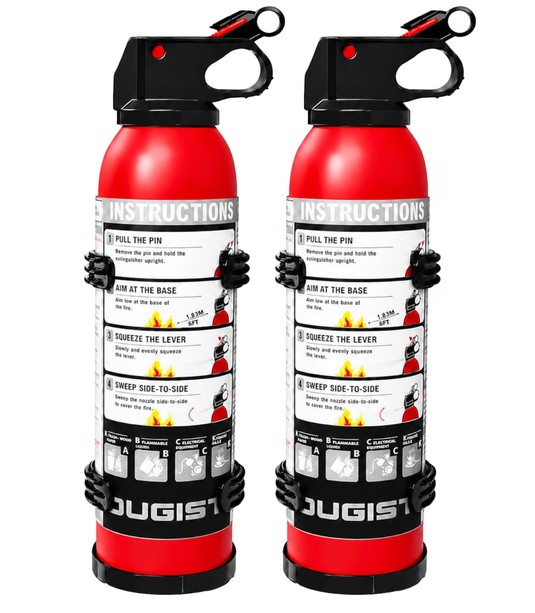
The Ougist portable ABC fire extinguisher two-pack offers an inexpensive way to add supplementary fire preparedness around a race car, trailer, garage, or paddock.
Each extinguisher is advertised as containing approximately 1.32 pounds of ABC dry-chemical extinguishing agent. The compact size is appealing for racers working with limited space.
For Enduro racing, that’s an important consideration. Many competitors race inexpensive cars with stripped interiors, racing seats, roll cages, and limited room for additional equipment.
I’ve installed compact fire extinguishers in my own Enduro race cars, so I understand the appeal of having something lightweight and easy to access rather than a bulky bottle taking up valuable cockpit space.
The Ougist listing also advertises mounting hardware, which makes it worth investigating for racers who need a compact solution.
However, the exact Ougist model’s racing certification, minimum fire rating, and mounting suitability have not been independently verified. Drivers must confirm that the extinguisher and its mount satisfy their racing organization’s requirements before using it as mandatory in-car equipment.
Ougist Advantages
- Affordable two-pack for budget-conscious racers.
- Compact and portable design.
- ABC dry-chemical product marketed for several common fire categories.
- Useful to consider for supplementary garage, trailer, and paddock preparedness.
- Advertised mounting hardware.
Ougist Limitations
- Smaller extinguishing-agent capacity than many conventional racing extinguishers.
- Race-specific certification has not been verified.
- The mounting bracket must be appropriate for racing conditions.
- Not a replacement for a required certified onboard fire-suppression system.
My assessment: For grassroots racers, the Ougist two-pack is an affordable option worth investigating. Its compact size is attractive, but race eligibility should be confirmed before installing it to satisfy an event’s extinguisher requirement.
View Ougist Portable ABC Fire Extinguishers on Amazon
2. Lifeline Zero 2020 Racing Fire System — Best Professional Option
Best for: Higher-budget race cars where a properly certified onboard fire-suppression system is required or desired.
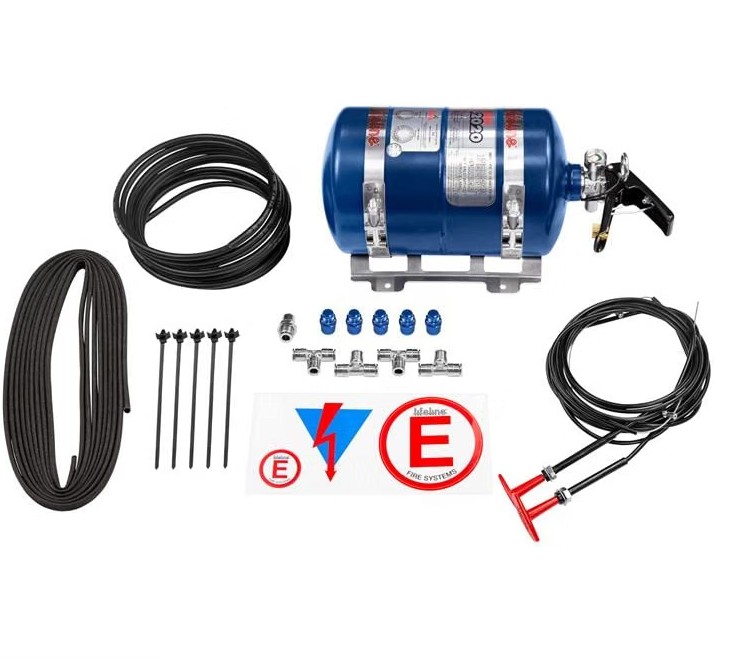
The Lifeline Zero 2020 takes a completely different approach to fire protection.
Instead of requiring the driver to retrieve and operate a handheld extinguisher, this system is designed to distribute extinguishing agent through installed tubing and nozzles positioned in designated areas of the race car.
Depending on the exact configuration, the system includes a suppression cylinder, activation hardware, tubing, and discharge nozzles.
One of the biggest advantages is that the driver may be able to activate the system while remaining secured in the racing seat.
That’s important because getting out of a race car isn’t always easy, especially when you’re wearing a helmet, fire suit, and multi-point racing harness.
The Lifeline Zero 2020 is associated with FIA-approved motorsports fire-suppression configurations. However, racers should understand that FIA approval and SFI 17.1 certification are not interchangeable.
If your racing organization requires SFI 17.1, verify that you’re purchasing a system explicitly certified to that standard. Don’t assume every Lifeline system qualifies.
Lifeline Advantages
- Purpose-built motorsports fire-suppression equipment.
- Installed tubing and nozzles distribute suppressant to designated areas.
- Can provide activation access while the driver remains belted in.
- Appropriate to investigate for competition cars requiring an onboard system.
Lifeline Limitations
- Considerably more expensive than portable extinguishers.
- Requires careful installation and ongoing servicing.
- Certification must match the racing organization’s rules.
- The exact kit contents and approval should be verified before purchasing.
My assessment: For a higher-budget competition car, a properly installed onboard fire-suppression system is worth serious consideration. The Lifeline Zero 2020 may be appropriate where its specific FIA approval is accepted, but drivers must verify the exact model against their rulebook.
View Lifeline Zero 2020 Racing Fire System on Amazon
Portable Fire Extinguisher vs. Onboard Fire-Suppression System
The biggest difference between these two products isn’t just price. It’s how they’re designed to work.
A portable fire extinguisher requires someone to retrieve it, aim it, and manually discharge the extinguishing agent. It can be useful for a small, accessible fire when the operator has appropriate training and a safe escape route.
An onboard fire-suppression system uses installed components to distribute extinguishing agent to selected locations, potentially including the cockpit and engine compartment.
Depending on the system, activation may be manual or automatic.
Neither option guarantees survival in a vehicle fire. The driver’s priority should always be escaping danger and allowing trained emergency personnel to respond.
Why Fire Extinguisher Cost Matters in Enduro Racing
Enduro racing is different from many professional motorsports divisions.
Drivers frequently compete in inexpensive cars, and some events have claim rules that influence how much money competitors are willing to invest in their vehicles.
I’ve been involved in circle track racing since 1994, beginning my career at Raceway Park in Shakopee, Minnesota. Over the years, I’ve raced everything from grassroots Enduro cars to NASCAR Late Models, accumulating victories at more than 13 racetracks throughout the Upper Midwest.
Today, I enjoy returning to Enduro racing because it’s an affordable and entertaining way to enjoy the sport.
When you’re building a budget race car, every dollar matters.
Spending hundreds of dollars on a permanently installed suppression system may not be practical for a low-cost Enduro car, especially when the series doesn’t require that type of system.
However, saving money should never mean ignoring minimum safety requirements.
The right fire extinguisher is one that meets your racing organization’s rules, can be mounted securely, and provides appropriate protection for its intended use.
Race Car Fire Extinguisher Rules: What Drivers Need to Know
There is no universal extinguisher rule that applies to every Enduro race, dirt track, asphalt oval, or professional motorsports organization.
Some grassroots racing series require a securely mounted portable fire extinguisher. Others specify minimum capacity, fire ratings, approved mounting brackets, or certified onboard systems.
The SMP Enduro Racing Series requires participating race cars to carry a fire extinguisher. Drivers may select their own extinguisher, provided it satisfies the series’ applicable requirements.
Other racing organizations may impose stricter standards.
Before purchasing, check these five important details:
- Extinguisher capacity: Does the rulebook specify a minimum amount of extinguishing agent?
- Fire rating: Is a particular UL rating or other independent certification required?
- Mounting hardware: Does the extinguisher need a metal quick-release bracket or another approved mount?
- Accessibility: Can the extinguisher or activation control be accessed as required?
- Inspection and maintenance: Is the equipment charged, undamaged, properly serviced, and ready for use?
For additional safety information, consult the Sports Car Club of America, the SFI Foundation, and the Lifeline technical resources.
How to Mount a Fire Extinguisher in a Race Car
Proper mounting is just as important as selecting the extinguisher.
A loose extinguisher inside a race car can become a dangerous projectile during a collision or rollover.
The mounting location should not interfere with steering, pedals, seat belts, or the driver’s emergency exit.
It should also allow the extinguisher to remain securely retained during racing conditions.
If your racing organization requires a metal quick-release bracket, a basic plastic storage holder is not an acceptable substitute.
For onboard suppression systems, follow the manufacturer’s installation instructions for the cylinder, tubing, nozzles, and activation controls.
Don’t Forget Your Other Racing Safety Equipment
A fire extinguisher is only one part of a complete racing safety setup.
Drivers should also consider properly rated fire suits, gloves, footwear, helmets, and racing harnesses.
We’ve covered several of these topics in our other racing safety guides:
Frequently Asked Questions About Race Car Fire Extinguishers
What size fire extinguisher do I need for a race car?
The required size depends on your racing organization’s rules. Some events allow compact portable extinguishers, while others specify minimum capacities or ratings. Always check the current rulebook.
Are ABC fire extinguishers good for race cars?
ABC dry-chemical extinguishers are designed for several common fire classes. However, an ABC label alone doesn’t establish that an extinguisher meets competition requirements. Capacity, certification, and mounting also matter.
Is an onboard fire-suppression system better than a handheld extinguisher?
An onboard system can distribute suppressant to designated locations without requiring the driver to retrieve and aim a handheld bottle. However, effectiveness depends on the system design, installation, maintenance, and fire conditions.
Can I install a fire extinguisher myself?
Some portable extinguishers can be installed using suitable mounting hardware, provided the installation meets the racing organization’s requirements. More complex onboard systems should be installed according to the manufacturer’s instructions.
Do Enduro race cars need fire extinguishers?
Many Enduro racing organizations require fire extinguishers, including the SMP Enduro Racing Series. Requirements vary, so check the rules for your particular event.
Final Verdict: Which Race Car Fire Extinguisher Should You Buy?
For grassroots racers on a limited budget, begin by determining what your racing organization requires.
The Ougist portable ABC fire extinguisher two-pack offers an inexpensive, compact option for supplementary fire preparedness. Before relying on it as mandatory in-car equipment, confirm that its exact specifications and mounting hardware meet your series’ rules.
View Ougist Portable Fire Extinguishers on Amazon
For higher-budget competition cars, an appropriately certified onboard fire-suppression system can provide a more integrated approach to fire protection.
The Lifeline Zero 2020 is an option to investigate where its specific FIA approval is accepted. If your rules require SFI 17.1, select a system explicitly certified to that standard.
View Lifeline Racing Fire System on Amazon
My advice after more than 30 years of racing: Don’t choose fire-protection equipment based on price alone. Choose equipment that meets your racing rules, install it correctly, maintain it properly, and always be prepared to exit the car quickly in an emergency.
Affiliate disclosure: As an Amazon Associate, I earn from qualifying purchases. Ougist also participates in an Amazon Creator Connections campaign that may provide additional commissions on qualifying purchases. Product recommendations are based on their stated features, safety considerations, and intended applications.

About the Author
Troy Tuma has been involved in circle track racing for over 30 years. His racing career began in 1994 at Raceway Park in Shakopee, Minnesota, competing in Enduro races before working his way up through the ranks to NASCAR Late Model racing. Throughout his career, Troy has earned victories at more than 13 racetracks across the Upper Midwest. Today, he enjoys returning to his grassroots racing roots, competing in Enduro events throughout the Midwest for the simple enjoyment and excitement of racing.