
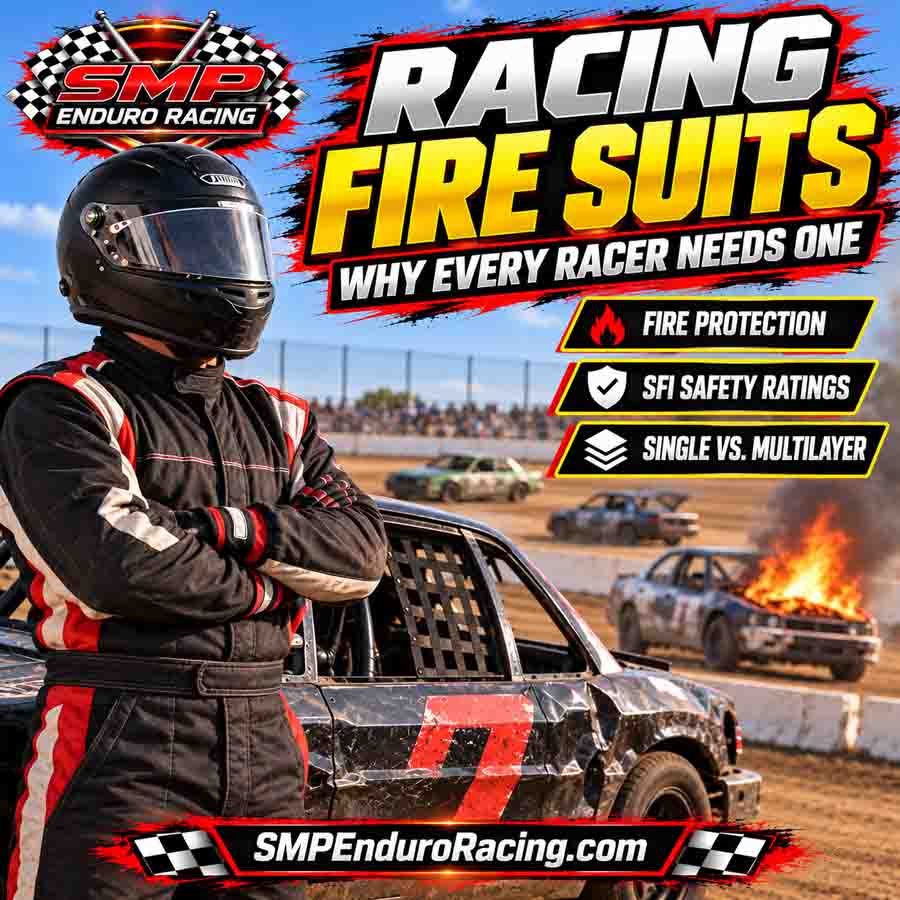
A Racing Fire Suit is one of the most important pieces of safety equipment a race car driver can wear. Whether you’re competing in Enduro racing, dirt-track stock cars, drag racing, circle-track racing, or other grassroots motorsports, protecting yourself against fire and extreme heat should always be a priority.
Affiliate Disclosure: This page contains affiliate links. Commissions earned from this page help maintain this website.
Many beginner racers focus on building a faster race car before investing in proper safety equipment. But a fire doesn’t care how much your race car is worth, how much experience you have, or how many laps you’ve completed. A mechanical failure, fuel leak, or serious crash can create a dangerous situation without warning.
At SMP Enduro Racing, safety is our number-one priority. After more than 30 years around Enduro racing, I’ve learned that the driver is always more valuable than the race car.
In this guide, we’ll explain why racing fire suits are important, how fire-resistant racing clothing works, what SFI ratings mean, the differences between single-layer and multilayer suits, and why every driver should take fire protection seriously.
1. Why Do Race Car Drivers Wear Fire Suits?
Race car drivers wear fire suits to reduce the risk of serious burns from flames and intense heat during an accident.
A properly rated racing fire suit is designed to resist ignition and slow heat transfer, potentially providing valuable time for a driver to escape a burning vehicle or receive assistance.
Unlike ordinary street clothing, racing fire suits are constructed from materials designed for motorsports fire hazards.
A racing fire suit helps protect against:
- Flames caused by leaking or ignited fuel.
- Intense heat from an engine compartment fire.
- Brief flame exposure while escaping a burning vehicle.
- Heat exposure during multi-car accidents.
- Certain burn hazards involving hot or flammable fluids.
However, it’s important to understand that fire-resistant does not mean fireproof. No racing suit can guarantee protection against every fire.
A racing suit is one important component of a complete driver safety system.
2. I’ve Personally Witnessed Race Cars Catch Fire
After more than 30 years around Enduro racing, I’ve personally witnessed race cars catch fire, including during Enduro events.
Fortunately, I’ve never witnessed a serious burn injury from those incidents.
But seeing a race car catch fire is enough to remind you how quickly a normal race can turn into an emergency.
Grassroots racing often involves older production vehicles that have been modified for competition. These cars may have relocated batteries, modified fuel systems, custom exhaust components, and additional safety equipment.
Even when a car is properly prepared, mechanical failures and accidents can still happen.
A collision can damage a fuel line, electrical wiring, or another component and create a dangerous situation.
The time to prepare for a racing fire is before it happens, not after flames appear.
That’s why I believe fire protection should be one of the first things a driver considers when building a race car.
3. Ten Reasons Every Racer Should Wear a Fire-Resistant Racing Suit
Reason 1: Protection Against Flames
The primary purpose of a racing fire suit is to resist ignition and reduce heat transfer during exposure to flames.
A properly rated suit can help protect the driver’s body when a vehicle catches fire.
Ordinary clothing isn’t designed or tested for this type of exposure.
Reason 2: Additional Time to Escape
When a race car catches fire, every second matters.
A fire-resistant racing suit may provide additional time for a driver to release the racing harness, exit the vehicle, and move away from danger.
That additional protection can be extremely valuable, although no suit guarantees a particular amount of safe escape time.
Reason 3: Protection Against Extreme Heat
You don’t necessarily have to touch flames to suffer a burn.
Intense radiant heat from a nearby fire can injure exposed skin.
Racing fire suits are designed to reduce heat transfer and provide a protective barrier against thermal exposure.
Reason 4: Reduced Risk from Burning Clothing
Ordinary clothing can ignite, melt, or continue burning under certain conditions.
Some synthetic materials can melt against the skin when exposed to high temperatures.
Purpose-built fire-resistant racing clothing is designed to reduce these hazards.
Reason 5: Protection During Fuel-Related Fires
Race cars contain gasoline, oil, and other fluids that can create serious hazards during a crash.
A damaged fuel line, leaking fuel cell, or electrical problem can contribute to a vehicle fire.
A racing fire suit provides an important layer of protection, although fuel or chemical contamination can reduce its effectiveness.
Reason 6: Protection During Multi-Car Accidents
Enduro racing and other forms of close-quarters motorsports involve the possibility of several vehicles becoming involved in the same accident.
A driver may not always be able to exit immediately.
A damaged door, steering column, or other component can make escaping more difficult.
Fire-resistant clothing is especially important when a driver cannot get out of the vehicle as quickly as expected.
Reason 7: Better Overall Driver Protection
A racing fire suit works together with other safety equipment, including racing helmets, harnesses, gloves, shoes, and properly constructed roll cages.
Each piece of equipment serves a different purpose.
A complete safety system is much more important than relying on any single piece of protection.
Reason 8: Meeting Racing Organization Requirements
Many racing organizations require drivers to wear fire-resistant racing suits.
Some organizations specify particular SFI or FIA ratings, while others have different minimum requirements.
Before buying a suit, always check the rules for the racing series and class where you plan to compete.
Reason 9: Peace of Mind Behind the Wheel
Drivers already have plenty to concentrate on during a race.
Knowing you’ve invested in proper safety equipment can give you greater confidence that you’ve prepared responsibly.
You still need to respect the risks, but you won’t be wondering whether you overlooked something important.
Reason 10: Your Safety Is Worth More Than Your Race Car
Whether you’re racing a $500 Enduro car or a $50,000 purpose-built race car, the potential consequences of a serious fire can be devastating.
An inexpensive race car doesn’t mean you should compromise on personal safety.
Your race car can be replaced. You cannot.
4. My Personal Racing Fire Suit Cost $1,000 — And I Don’t Regret It
I personally wear an expensive multilayer racing fire suit.
When I purchased it, the suit alone cost approximately $1,000.
Some grassroots racers might think that’s an unnecessary expense, especially when they’re racing an inexpensive car.
But I look at safety differently.
There is no price I can put on my personal safety.
That doesn’t mean every beginner needs to spend $1,000 on a racing suit. Affordable suits are available, and some meet the minimum requirements of grassroots racing organizations.
But when I purchase safety equipment, I don’t automatically choose the cheapest option.
I consider the protection I’m getting and what could happen if something goes wrong.
I’ve always believed you can regret not having enough safety equipment, but you’re unlikely to regret having better protection during a serious accident.
My advice to new racers is simple:
Don’t spend your entire racing budget making the car faster while leaving yourself underprotected.
5. Single-Layer vs. Multilayer Racing Fire Suits
One of the first decisions you’ll face when shopping for a racing fire suit is whether to purchase a single-layer or multilayer design.
Both are used in motorsports, but their thermal protection can vary significantly.
Single-Layer Racing Fire Suits
Single-layer racing suits are often the most affordable option.
They may be suitable for certain entry-level racing classes when they meet the applicable safety requirements.
Some single-layer suits use treated fire-resistant cotton or other protective materials.
However, many entry-level suits provide less thermal protection than higher-rated alternatives.
The important thing is to check the suit’s actual certification rather than assuming every single-layer suit provides the same protection.
Multilayer Racing Fire Suits
Multilayer racing suits use additional protective materials designed to slow heat transfer.
These suits are often selected by drivers who want greater thermal protection.
They typically cost more than entry-level suits.
I personally prefer a multilayer suit because I want that additional level of protection.
However, the number of layers alone doesn’t determine a suit’s rating. Material selection, construction, and tested thermal performance all matter.
My recommendation: Start by meeting your racing organization’s requirements, then consider upgrading to a higher-rated suit if your budget allows.
6. Understanding SFI Racing Fire Suit Ratings
When shopping for racing fire suits, you’ll probably see certifications such as SFI 3.2A/1 and SFI 3.2A/5.
These ratings are established through the SFI Foundation’s motorsports safety equipment standards.
SFI ratings help identify the tested thermal protective performance of racing clothing.
Common categories include:
- SFI 3.2A/1: An entry-level thermal protection category often associated with economical racing suits.
- SFI 3.2A/5: A higher thermal protection category commonly found in multilayer racing suits.
- SFI 3.2A/10 and higher: Additional categories for greater tested thermal protective performance.
An important distinction is that an SFI rating is not simply the number of fabric layers.
For example, an SFI 3.2A/5 rating does not mean a suit has five layers.
The rating relates to thermal protective performance measured under standardized testing conditions.
Higher-rated suits generally provide greater protection under those test conditions, but the rating does not guarantee a specific amount of safe time inside an actual burning race car.
You can learn more from the SFI Foundation’s official website.
Some motorsports organizations use FIA clothing standards instead. Always verify which certifications are accepted by your racing series.
7. One-Piece vs. Two-Piece Racing Fire Suits
Racing fire suits are available in two common styles.
One-Piece Racing Fire Suits
A one-piece suit combines the jacket and pants into a single garment.
Many racers prefer this design because it provides continuous coverage without a separate jacket and pants.
Two-Piece Racing Fire Suits
A two-piece suit consists of a separate racing jacket and racing pants.
These suits are popular in some grassroots racing classes because they can be affordable and convenient.
However, proper overlap between the jacket and pants is important to avoid exposing skin during an accident.
What Does SMP Enduro Racing Require?
At SMP Enduro Racing, a racing fire suit is mandatory.
Our general requirement allows either a one-piece or two-piece racing fire suit.
We understand that grassroots racers operate on different budgets, so our goal is to maintain essential safety requirements while keeping racing accessible.
Drivers must comply with the current class rules and pass our pre-race safety inspection.
8. Why Safety Is the Number-One Priority at SMP Enduro Racing
At SMP Enduro Racing, we’re proud of the emphasis we place on driver safety.
We believe one of the biggest reasons for our strong safety record is our strict pre-race safety inspection process.
Before drivers compete, their cars and safety equipment are inspected for compliance with our rules.
This helps identify preventable safety problems before vehicles enter the racetrack.
Our safety requirements aren’t intended to make racing more expensive or difficult.
They’re designed to help protect drivers.
We’ve worked hard to maintain a strong safety culture, and serious injuries have been uncommon in our experience.
Although no racing organization can eliminate every risk or guarantee an injury-free event, we believe consistent inspections and safety enforcement make a meaningful difference.
Our goal is for every driver to enjoy the competition and return home safely afterward.
9. Why a $500 Race Car Still Needs a Racing Fire Suit
One of the biggest mistakes a beginner racer can make is assuming expensive safety equipment isn’t necessary because the race car itself is inexpensive.
I’ve heard that argument in different forms throughout my racing career.
My response is always the same:
It doesn’t matter what you’re driving. They all crash the same, and you want to be protected.
Of course, different cars and crashes involve different forces and hazards.
But an inexpensive Enduro car can still be involved in a serious accident.
The amount of money you spent purchasing or building the car doesn’t determine how much your life is worth.
A fire suit, racing harness, helmet, and properly constructed safety equipment are investments in the driver.
If you’re building your first race car, take a look at our Enduro Race Car Safety Equipment Checklist, which covers 16 important safety items and components.
10. What Should You Wear Under a Racing Fire Suit?
What you wear underneath your racing suit can affect your overall fire protection.
Fire-resistant racing underwear provides another layer of protection against heat and flames.
Depending on the racing organization and the suit’s certification, certain protective undergarments may be required.
Consider using:
- Fire-resistant long-sleeve racing underwear.
- Fire-resistant racing underwear bottoms.
- Fire-resistant socks.
- Properly rated racing gloves.
- Fire-resistant racing shoes.
- A fire-resistant head sock or balaclava when appropriate.
Avoid assuming ordinary synthetic athletic clothing is safe underneath a racing suit.
Some synthetic materials can melt when exposed to extreme heat.
Always follow the manufacturer’s recommendations and the requirements of your racing organization.
11. Why Racing Gloves and Shoes Are Important
A racing fire suit protects much of the driver’s body, but it doesn’t fully protect the hands, feet, or head.
Those areas need additional protection.
Racing gloves are particularly important because a driver may need to operate the steering wheel, release the harness, remove the window net, or open an exit during an emergency.
Burned or injured hands can make escaping much more difficult.
Fire-resistant racing gloves are designed to provide thermal protection while maintaining enough flexibility to operate vehicle controls.
Racing shoes and socks provide additional protection for the driver’s feet.
Browse Fire-Resistant Racing Gloves on Amazon
Always check the product’s actual certification and your racing organization’s requirements before purchasing.
12. How Should a Racing Fire Suit Fit?
A racing fire suit should fit comfortably while providing full coverage when you’re seated in the race car.
A suit that’s too tight can restrict movement and compress the insulating spaces within the clothing.
A suit that’s excessively loose can interfere with controls or create unnecessary bulk.
When shopping for a racing suit, consider the following:
- Can you comfortably move your arms and legs?
- Does the suit provide adequate coverage when seated?
- Are the sleeves and pant legs long enough?
- Does the collar fit properly?
- Can you operate the steering wheel and harness comfortably?
- Does the suit fit correctly when wearing racing underwear?
Whenever possible, try the suit on while sitting in a driving position.
Don’t rely entirely on how it fits while standing.
13. How to Clean and Maintain a Racing Fire Suit
A racing fire suit should be treated as safety equipment, not ordinary work clothing.
Fuel, oil, grease, and other contaminants can affect its protective performance.
One mistake racers sometimes make is wearing their racing suit while working on the car.
That can expose the suit to unnecessary dirt, grease, and chemicals.
Good maintenance practices include:
- Follow the manufacturer’s cleaning instructions.
- Keep the suit away from fuel, oil, and grease.
- Avoid cleaning chemicals prohibited by the manufacturer.
- Inspect the suit regularly for damage.
- Check zippers, seams, cuffs, and other closures.
- Store the suit in a clean, dry location.
- Replace the suit if damage or contamination compromises its protection.
Different materials have different cleaning requirements.
Never assume every racing suit can be washed the same way.
14. When Should You Replace a Racing Fire Suit?
There isn’t one universal replacement schedule for every racing fire suit.
A suit may need to be replaced if it becomes damaged, contaminated, excessively worn, or no longer meets the rules of your racing organization.
Warning signs include:
- Holes or tears in the fabric.
- Damaged stitching or seams.
- Broken zippers or closures.
- Significant wear in high-contact areas.
- Fuel or chemical contamination.
- Damage from a previous fire.
- Certification or condition that no longer meets applicable requirements.
Some suits and racing organizations have additional inspection or recertification requirements.
Check the manufacturer and sanctioning body’s instructions.
If you’re unsure whether a damaged suit is still safe, consult the manufacturer before using it again.
15. Where to Buy Racing Fire Suits
Racing fire suits are available through motorsports equipment suppliers and online retailers, including Amazon.
Prices vary depending on the brand, construction, certification, and level of thermal protection.
Before purchasing, compare:
- SFI or FIA certification.
- One-piece versus two-piece construction.
- Single-layer versus multilayer protection.
- Manufacturer reputation.
- Size and fit.
- Price and availability.
- Requirements for your racing class.
An inexpensive suit may be appropriate for some entry-level classes, but it should still meet the applicable safety rules.
If you’re considering upgrading your racing gear, you can compare available options here:
Shop Racing Fire Suits on Amazon
Remember that the cheapest suit isn’t automatically the best value.
Proper protection, certification, fit, and condition should come first.
16. A Racing Fire Suit Is Only One Part of a Complete Safety System
Even the best racing fire suit cannot prevent every injury.
Driver safety requires several different pieces of equipment working together.
Important components include:
- Properly installed racing harnesses.
- Appropriate racing seats.
- Properly constructed roll cages.
- Racing helmets.
- Fire-resistant gloves and shoes.
- Window nets.
- Safe fuel systems.
- Properly mounted fire extinguishers or required fire suppression systems.
- Emergency exit procedures.
A fire suit helps protect against thermal hazards, while other equipment addresses crash forces, driver containment, and different emergency situations.
If you’re upgrading your driver restraints, read our 5-Point Racing Harness Safety Guide to learn why a proper racing harness is another important part of driver protection.
Frequently Asked Questions About Racing Fire Suits
Do I Really Need a Racing Fire Suit for Enduro Racing?
At SMP Enduro Racing, a racing fire suit is mandatory. Other organizations may have different requirements, but fire-resistant clothing is an important safety consideration whenever race car fires are possible.
Is a Racing Fire Suit Actually Fireproof?
No. Racing fire suits are fire-resistant, not fireproof. They’re designed to resist ignition and slow heat transfer, but burns can still occur during serious fires.
Is a Single-Layer Racing Suit Good Enough?
A single-layer suit may meet the minimum requirements of certain racing classes. However, higher-rated suits can provide greater tested thermal protection. Always check the certification and your racing organization’s rules.
What Does SFI 3.2A/5 Mean?
SFI 3.2A/5 identifies a particular thermal protective performance category under the SFI driver suit specification. It doesn’t mean the suit has five layers or guarantees a specific amount of safe exposure time in a real fire.
Can I Wear a Two-Piece Racing Fire Suit?
Some racing organizations allow two-piece suits. SMP Enduro Racing permits both one-piece and two-piece fire suits under its general requirements. Proper coverage and compliance with current rules are important.
Can I Wear Regular Clothes Under My Racing Suit?
Follow the suit manufacturer’s recommendations and your racing organization’s requirements. Fire-resistant racing underwear provides additional protection, while some ordinary synthetic clothing can create hazards during extreme heat exposure.
How Much Should I Spend on a Racing Fire Suit?
Spend enough to obtain a properly rated suit that fits correctly and meets your racing organization’s requirements. More expensive suits may offer additional protection, but price alone doesn’t determine safety.
Can a Racing Fire Suit Protect Against Gasoline or Chemical Spills?
A racing fire suit is designed primarily for flame and thermal protection. It is not a chemical-protective suit. Fuel and chemical contamination can compromise its performance and create additional hazards.
Should I Buy a Used Racing Fire Suit?
Used suits can have hidden wear, damage, contamination, or outdated certification. If considering a used suit, inspect it carefully and confirm that it meets current requirements. A new suit from a reputable supplier is generally easier to evaluate.
Do Racing Fire Suits Expire?
Not every racing suit has the same replacement or recertification requirements. Suit condition, manufacturer instructions, certification, and racing organization rules determine whether it remains suitable for use.
Final Thoughts: Your Race Car Is Replaceable. You Are Not.
I’ve spent more than 30 years around Enduro racing, and I’ve seen enough crashes, mechanical failures, and race car fires to understand why driver safety matters.
I personally wear a multilayer racing fire suit because I believe the additional protection is worth the investment.
Not every racer needs to spend $1,000 on a suit like I did.
But every racer should take fire protection seriously.
At SMP Enduro Racing, we require fire suits and conduct strict pre-race safety inspections because we want drivers to compete in an environment where safety comes first.
Whether you’re building your first inexpensive Enduro car, racing a dirt-track stock car, or competing in another form of motorsports, remember one thing:
You can always replace a race car. You cannot replace yourself.
Protect yourself before you worry about making the car faster.
Browse Racing Fire Suits on Amazon
For more information about building a safer race car, visit our Enduro Race Car Safety Equipment Checklist.
SMPEnduroRacing.com — Grassroots Racing With Safety First.