
Enduro race car safety equipment should be one of the first things you consider when building a car for Enduro racing. A car that can survive 200 laps is important, but protecting the driver when something goes wrong is more important.
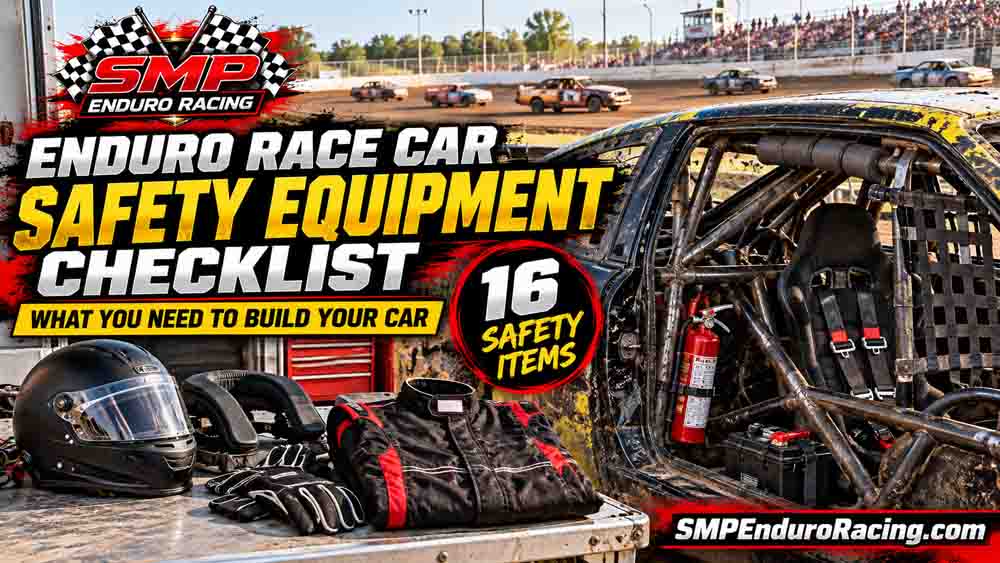
Enduro racing can mean heavy traffic, changing track conditions, disabled cars, debris, contact and long periods of racing without a break. The safety equipment in and around the driver’s compartment needs to be part of the build from the beginning—not something added the night before the race.
This Enduro race car safety equipment checklist covers 16 important items to consider when building or preparing a grassroots Enduro car. It is based in part on actual safety requirements and recommendations used by Southern Minnesota Promotions (SMP) Enduro Racing, along with practical considerations that apply to Enduro racers anywhere in the country.
Important: Rules vary between tracks, promoters and racing organizations. Always read the current rulebook for the specific event or series where you plan to race before purchasing or installing safety equipment. Your local rules and technical officials are the final authority.
Enduro Race Car Safety Equipment: Start With the Driver
A safety inspection should not be the first time you think about whether your Enduro car is safe.
The driver’s seat location, roll cage, harness mounting points, padding, fuel system, battery, fire extinguisher and driver controls can all affect one another. Planning these systems together can make the car safer and prevent expensive changes later.
At SMP Enduro Racing, cars must pass a safety inspection before entering the track. If something on the car is unsafe and cannot be corrected to your satisfaction, the rule is simple: do not race.
Here are 16 Enduro race car safety equipment items every new racer should understand.
#CommissionsEarned: As an Amazon Associate this site earns from qualifying purchases. Commissions help keep this site active. Some links below are Amazon affiliate links. Always verify equipment against the current rules where you race.
1. 5-Point Racing Harness
A 5-point racing harness is one of the most important pieces of Enduro race car safety equipment. SMP requires a 5-point racing harness with lap and shoulder belts in both Compact and Full-Size competition.
The purpose of the harness is to keep the driver properly restrained during hard impacts and sudden changes in direction. Installation matters just as much as the harness itself. Belt angles, mounting points, hardware, seat location and the driver’s position all need to work together.
Do not assume every harness advertised for racing meets the requirements of your track. Check your rulebook for specifications, certification requirements and any age restrictions before purchasing.
Browse 5-Point Racing Harnesses on Amazon →
2. Racing Fire Suit
A racing fire suit is mandatory for both SMP Compact and Full-Size Enduro drivers. Even a relatively stock Enduro car contains gasoline, oil, electrical wiring and extremely hot engine and exhaust components.
When choosing a fire suit, consider more than appearance or price. Fit, construction, fire-resistant properties and any certification required by your racing organization should all be considered.
The suit should also allow the driver to comfortably steer, operate controls and get in and out of the car.
Browse Racing Fire Suits on Amazon →
3. Fire-Retardant Racing Gloves
Racing gloves provide grip while adding another layer of protection for the driver’s hands. SMP highly recommends fire-retardant gloves for Compact Enduro racing.
Choose gloves designed for motorsports and make sure you can comfortably operate the steering wheel, shifter, switches and other controls while wearing them.
Browse Fire-Retardant Racing Gloves on Amazon →
4. Neck Brace or Racing Neck Restraint
During a sudden impact, the racing harness restrains the driver’s body while the head can continue moving. Neck restraints are designed to provide additional protection during that movement.
SMP highly recommends neck protection in both Compact and Full-Size competition.
Different restraint systems work differently, so consider compatibility with your helmet, harness and seat rather than buying strictly by price.
Browse Racing Neck Restraints and Neck Braces on Amazon →
5. Racing Window Net
A racing window net can help keep the driver’s arms and upper body within the protected area of the car during a rollover or side impact. SMP highly recommends window nets in both Compact and Full-Size Enduro cars.
Mounting and placement matter. The driver should also be able to release the window net quickly when exiting the car.
Browse Racing Window Nets on Amazon
6. Roll-Bar and Roll-Cage Padding
A roll cage protects the driver’s compartment, but exposed cage tubing can itself become a hazard if the driver’s helmet or body contacts it during an accident.
SMP Full-Size rules specifically require roll-cage foam to help protect the driver’s head. Padding appropriate cage tubing around the driver should be considered when preparing any Enduro car.
Pay particular attention to bars that the driver’s helmet, arms or legs could contact while the driver is properly restrained.
Browse Roll-Bar and Roll-Cage Padding on Amazon →
7. Fire Extinguisher and Vehicle Mount
SMP requires a fire extinguisher securely mounted within the driver’s reach.
The words securely mounted are important. A fire extinguisher cannot become a loose object inside the driver’s compartment during an accident, but the driver also needs to be able to reach and release it when necessary.
Check your local rules for extinguisher type, size and mounting requirements.
Browse Fire Extinguishers and Vehicle Mounts on Amazon →
8. Marine Battery Box With Cover
SMP rules allow the battery to remain securely mounted under the hood or be relocated to the driver’s compartment inside a securely mounted marine-style battery box with a cover.
A battery contains considerable stored electrical energy and needs to remain secured during an impact. If it is relocated inside the driver’s compartment, proper containment and mounting become particularly important.
Browse Marine Battery Boxes With Covers on Amazon →
9. Racing Fuel Cell
Fuel-system safety deserves extra attention in any Enduro race car.
SMP Full-Size rules require the stock fuel tank to be removed and replaced with a racing fuel cell or another approved steel thick-walled tank. SMP Compact rules may allow the stock tank when it is located in front of the rear axle; otherwise an approved replacement is required.
Fuel-cell capacity, construction, location, mounting straps, enclosure and fuel-line routing can all be regulated.
Never assume a product is legal simply because it is advertised as a racing fuel cell. Check your rulebook before ordering or installing one.
Browse Racing Fuel Cells on Amazon →
10. Steel-Braided Fuel Line
SMP Full-Size rules require steel-braided fuel line when a fuel line passes through the driver’s compartment.
A fuel leak around the driver can create an immediate hazard. Make sure the hose, fittings and installation are compatible with your fuel system and comply with the rules where you race.
Browse Steel-Braided Fuel Line on Amazon →
11. Electric Fuel-Pump Shutoff Switch
An electric fuel pump can continue supplying fuel unless power to the pump is interrupted.
SMP Full-Size cars equipped with an electric fuel pump must have a shutoff switch on the driver’s left side. The switch must be clearly marked and accessible to track personnel.
Switch placement is something worth planning while building the car instead of adding it as an afterthought.
Browse Electric Fuel-Pump Shutoff Switches on Amazon →
12. Race Receiver
Communication with race officials is another important part of Enduro racing safety. SMP requires a Race Receiver one-way communication device for drivers.
Race control can use the receiver to give drivers instructions during changing track conditions, incidents and other situations. With a large field of Enduro cars on the track, receiving those instructions can be particularly important.
Always verify that a receiver is compatible with the system used by your track or series before purchasing.
Browse Race Receivers on Amazon →
13. Race Receiver Earbuds
A Race Receiver only works if the driver can clearly hear it over the noise of a race car. SMP instructs drivers to bring their own earbuds.
The earbuds need to work comfortably underneath the driver’s helmet without interfering with proper helmet fit.
Browse Race Receiver Earbuds on Amazon →
14. Transponder Mount or Holder
SMP uses electronic MyLaps scoring, and every car must have a compatible car-racing transponder. Drivers who don’t own one may be able to rent one at an SMP event, but the driver is responsible for having the proper mount.
A transponder mount is easy to overlook during a build. Make sure the mount you purchase is compatible with the actual transponder being used by your scoring system.
Browse Racing Transponder Mounts and Holders on Amazon →
15. 1-Inch Racing Lug Nuts
SMP Compact rules recommend 1-inch lug nuts, while SMP Full-Size rules require 1-inch lug nuts on the right side of the car.
Long Enduro races can put considerable stress on wheels, studs and suspension components. Inspect wheel studs, lug nuts and wheels as part of your regular pre-race preparation.
Always verify thread size and wheel compatibility before ordering lug nuts.
Browse 1-Inch Racing Lug Nuts on Amazon →
16. Full-Face Racing Helmet
A helmet is one area where choosing Enduro race car safety equipment based primarily on price is a bad strategy.
SMP requires helmets and eye protection during race conditions, and the Full-Size rules highly recommend a full-face helmet. Full-face coverage can provide additional protection for the driver’s face and eyes in an environment where dirt, debris and contact are part of racing.
Proper helmet fit is extremely important. Certification requirements can also vary between racing organizations and can change over time.
Before purchasing a helmet, verify the current requirements of the organization where you intend to race. Never assume a helmet is acceptable for competition simply because the product description contains the word racing.
Browse Full-Face Racing Helmets on Amazon →
Enduro Race Car Safety Equipment Beyond the Shopping List
Some of the most important safety components on an Enduro car aren’t things we recommend choosing from a generic online shopping list.
Roll Cage and Driver Protection
SMP Compact rules require a minimum 4-point driver-protection cage using 1 1/2-inch tubing. Full-Size rules require a minimum 6-point cage and include additional requirements for door bars and a perimeter cage around the driver.
The cage also needs proper clearance above the driver’s helmet. If you don’t have the fabrication experience to build a safe cage, getting help from an experienced race-car fabricator can be money well spent.
Rock Screen and Windshield Protection
When the original windshield is removed, driver protection still needs to remain in place. SMP rules require a heavy-gauge rock screen with at least three supports in the applicable configurations.
Proper material, fabrication and installation matter more here than simply ordering a generic piece of mesh.
Fuel-System Inspection
SMP rules state that a car leaking gasoline will be black flagged and must leave the track immediately.
Inspect the fuel tank or fuel cell, lines, fittings, filters and mounting system before every event. SMP rules also prohibit plastic fuel filters and contain specific requirements for fuel-tank protection and mounting.
Enduro Race Car Safety Equipment Pre-Race Checklist
Before loading your car for an event, perform your own safety inspection. A few minutes in the shop can uncover a problem that you don’t want to discover after the green flag.
- Inspect the 5-point racing harness and mounting points.
- Check the driver’s seat and seat mounting.
- Inspect roll-cage welds, mounting points and padding.
- Verify the fire extinguisher is secure and accessible.
- Inspect the fuel tank or fuel cell, straps, lines and fittings.
- Check battery mounting and the battery box where applicable.
- Test the fuel-pump shutoff system where required.
- Inspect wheel studs, lug nuts, wheels and tires.
- Check the window net and other driver-protection equipment.
- Inspect your helmet, fire suit, gloves and neck protection.
- Test your Race Receiver and earbuds.
- Verify the transponder and mount are ready.
- Check doors, bumpers, hood and required body components.
- Inspect floor pans and firewalls and seal required openings.
What Enduro Race Car Safety Equipment Should You Buy First?
If you’re building your first Enduro car, start with the rulebook before starting the shopping list.
Determine what your series requires for the roll cage, racing harness, helmet, fire suit, fuel system, battery, fire extinguisher and communications equipment. Then design the driver’s compartment around those requirements.
Buying equipment first and trying to make everything fit later can cost more money and create unnecessary problems at safety inspection.
Don’t blindly copy another race car either. Equipment that passes inspection at one track or with one organization may not meet the rules somewhere else.
Enduro Race Car Safety Equipment FAQ
What safety equipment does an Enduro race car need?
Many Enduro organizations require a racing harness. SMP requires a 5-point racing harness in both Compact and Full-Size competition. Always verify the requirements where you plan to race.
Do I need a fire suit for Enduro racing?
SMP requires a fire suit in both Compact and Full-Size competition. Requirements elsewhere can vary, so check the current rulebook for your event.
Do I need a full-face racing helmet?
SMP requires a helmet and eye protection during race conditions and highly recommends a full-face helmet in Full-Size competition. Other tracks and organizations may have specific helmet or certification requirements.
Does an Enduro race car need a fire extinguisher?
SMP requires a fire extinguisher securely mounted within the driver’s reach. Other organizations may have different requirements for extinguisher size, type and mounting location.
Do Enduro cars need a Race Receiver?
SMP requires a one-way Race Receiver for all drivers during competition. Race control uses it to communicate instructions and important information to drivers on the track. Other Enduro racing organizations may use different communication systems, so always check the rules for the track or series where you plan to race.
Build the Car to Finish the Race—and Protect the Driver
Winning an Enduro isn’t just about making a car fast. First, the car and driver have to survive the race.
Good Enduro race car safety equipment, a properly prepared driver’s compartment, a secure fuel system and careful pre-race inspection all help give the driver a safer environment when things don’t go according to plan.
After decades around Enduro racing, one lesson remains simple: if you see something on your car that you believe is unsafe, fix it before you race.
Use this Enduro race car safety equipment checklist as a starting point, then compare every component and installation against the current rules for the track or series where you plan to compete.
Race hard. Build smart. Put driver safety first.